

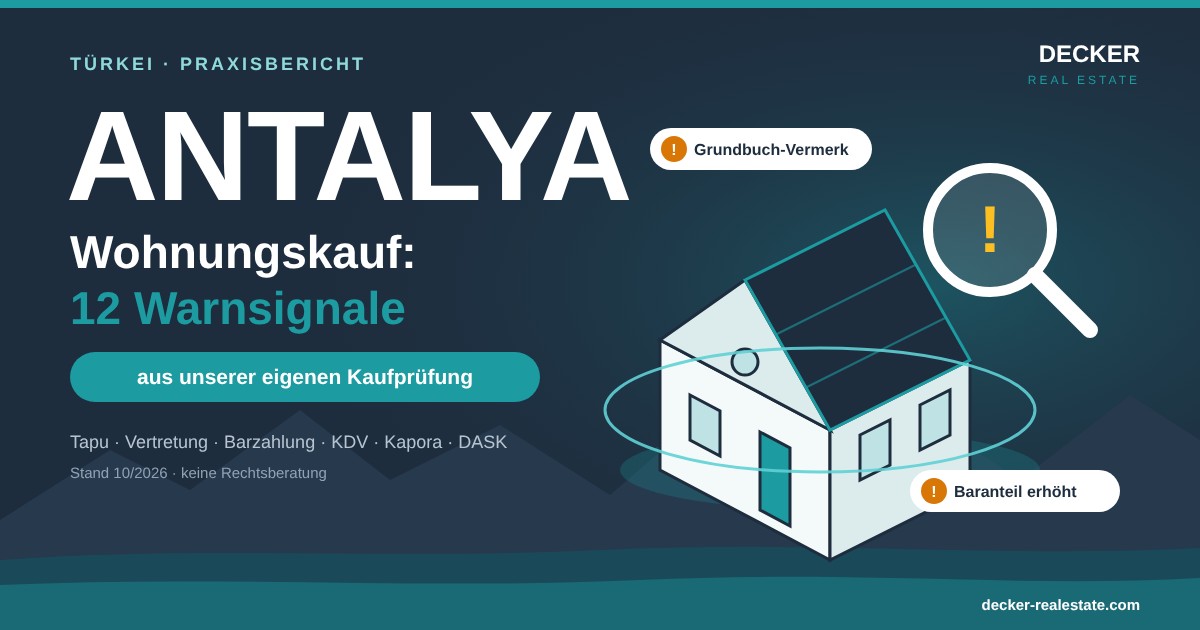
Buying an apartment in Antalya: 12 warning signs from our own purchase review
A personal account from Decker Real Estate: Contract risks, unclear documents, cash payments and the question of who to really trust when buying real estate in Turkey.
· · Decker Real Estate Approx. 13 min. reading time
12 Warning signs
from our own purchase review
- First check.
- Then understand.
- Then sign.
Ongoing purchase process · anonymized · not legal advice
Sources: own purchase review (ongoing, anonymized), İmar Kanunu No. 3194, DASK, TKGM, Resmî Gazete 21.08.2026 — Status: 29.10.2026
For years, we've been assisting people with property purchases in Turkey. We inspect properties, compare prices, support negotiations, and regularly deal with the procedures at the Turkish land registry, the Tapu. But what happens when we ourselves are on the buyer's side? We're currently experiencing exactly that with our own apartment purchase in Antalya.
Initially, we had found a specific property, negotiated the price, and were already well into the purchase preparations. The apartment complex made a good impression, the apartment met our requirements, and we had all the essential documents. All that was really missing was the signature. However, the more closely we examined the contract documents and the actual circumstances, the more questions arose.
In 30 seconds: the three most important warning signs
No time for the whole article? In the short video, we show the three points that concerned us the most during our own purchase review.
Note: Speaker avatar and voice are AI-generated.
The risk radar: 12 warning signs in four areas
Before we go into the details, the radar provides an overview. The twelve points are distributed across four areas that must be checked independently of each other when buying an apartment in Antalya. One clean area does not compensate for an unclear one in another.
1A high-quality residential complex does not necessarily guarantee a purchase decision.
Our search began like that of many other buyers: We compared various residential complexes in Antalya, especially in the Altıntaş district. In addition to the purchase price, construction quality, location, amenities, running costs and later resale potential played an important role.
Some developments, for example, offered modern technology, underfloor heating, underground parking, security services, and well-maintained common areas. Especially with completed projects, this can quickly create the impression that the main risks have already been eliminated. However, several checks lie between an attractive offer and a secure purchase decision.
2Advertised security and actual access control are two different things.
During our viewing, however, we noticed something that real estate advertisements rarely describe adequately. While the residential complex did have security features, certain entrances to the building were not as controlled as we would have expected from such a facility.
We were particularly interested in whether unauthorized individuals could access the apartment doors via the underground parking garage, side entrances, or elevators. A building may have cameras, security personnel, and modern entrance doors. However, if certain routes remain uncontrolled, the security concept is inconsistent. In response to our inquiries, we were told about additional doors or future retrofitting. While this could be a sensible solution, a measure announced is not necessarily a measure implemented.
3Kat Mülkiyeti and İskan are present – further examination is still necessary
Two documents are particularly frequently highlighted by sellers in Turkish real estate transactions. Kat Mülkiyeti refers to the condominium ownership registered in the land register. İskan, officially Yapı Kullanma İzin Belgesi, In contrast, the official permit for use is crucial. Both documents are important positive attributes, and they also played a significant role in our purchase project.
Nevertheless, we found that even with this documentation, questions can remain unanswered. Its existence does not automatically answer the question of whether all subsequent structural changes are approved, whether additional official entries exist, or whether all common areas conform to the approved project.
4The land registry entry that particularly caught our attention
One of the most important points of our examination was an official entry in the land register relating to Article 32 of the Turkish Building Code, İmar Kanunu No. 3194. Article 32 addresses, among other things, construction work carried out without the required permit or in deviation from the approved building plans. Depending on the circumstances, this can lead to official action, requirements for rectification, or even demolition issues.
The distinction is important: Such a statement alone does not indicate what specific deviation exists, whether a particular apartment is affected, or whether the matter has already been resolved.
In our case, it was initially unclear which building components or areas were affected by the contamination and what further consequences might exist. Furthermore, questions arose regarding communal areas and necessary structural modifications. This was a crucial point for us.
Example presentation, not an official document and not an extract from the TKGM system.
We would require these 5 pieces of evidence in comparable cases.
The complete, current land register extract with all entries and encumbrances (Takyidat).
The official letter on which the entry in question is based.
The relevant building files and, if applicable, official decisions.
A written confirmation from the relevant authority regarding the current status.
A legal and, if necessary, structural engineering assessment of the actual consequences.
5Who is actually the seller – and who is authorized to sign?
Furthermore, another aspect of our purchase preparations concerned the seller. The property didn't belong to a private individual, but to a company. This raises different questions than in a typical private sale: Who is the registered owner in the land register? Who are the shareholders, who manages the company, and who is legally authorized to represent the company in a property sale?
In our specific case, we had to examine the relationships between the individuals involved and their respective roles more closely. Additionally, the representative named in the draft contract changed between two versions. While this isn't inherently problematic, it makes a current review of the representative's authority all the more crucial.
6The purchase agreement: Why we completely reread every new version
During contract negotiations, several drafts often circulate back and forth. Sometimes someone adjusts a payment deadline, sometimes someone adds a clause. Occasionally, individual amounts or the details of the representative also change. We, too, received revised versions of the contract, and not all of the changes were merely editorial.
Example presentation with placeholders. No actual contract details, names, or amounts.
Therefore, it was crucial for us to, not only to check whether a requested correction has been made, but to reread the entire new contract. A correction in one place can create additional inconsistencies elsewhere. Inconsistencies between these points are particularly critical:
Do the total amount and the installments match?
Is every payment made recorded?
Do deadlines and sanctions align?
When is what due?
7Cash payment when buying real estate – why we became particularly cautious
Particularly noteworthy was the planned division of the purchase price. Initially, a significant portion was to be paid by bank transfer, with another amount in cash. During the course of the contract negotiations, this cash portion even increased. This does not automatically mean that an unlawful payment was intended. However, larger cash payments do entail additional risks.
How is the payment clearly proven? Who confirms receipt? Is it fully and correctly recorded in the contract and tax documents? And what happens if the transfer of ownership fails at the tapu (title deed)? It would be particularly problematic if the actual purchase price payment did not correspond to the documented agreements and official information.
8Is the agreed purchase price really the final price? The customer service risk
In the case of a sale by a company, Turkish VAT may also apply., KDV (Katma Değer Vergisi), This is relevant. For buyers, it is therefore crucial whether the offered purchase price already includes any applicable customer service charges. In our negotiations, a total price including customer service charges was stipulated, and this had to remain clearly identifiable in the contract.
An unclear agreement can lead to disputes about whether additional tax is due on top of the agreed purchase price. Which VAT regulation applies in a specific case depends on the actual tax circumstances and must be examined individually.
9Kapora, withdrawal periods and contractual penalties: three different risks
Another area of review was the down payment, which is usually... Kapora As mentioned, during the negotiations we had already transferred an amount that was only explicitly addressed in a later version of the contract. Especially with down payments, it is therefore essential to clearly stipulate who receives the amount, against which purchase price it is credited, under what conditions it is refunded, and what happens in the event of a failed transfer of ownership.
Furthermore, we had to examine the cancellation and penalty clauses more closely. Deadlines, repayment claims, and potential compensation must be consistent and coordinated. If several clauses stipulate different sanctions for the same situation, significant legal uncertainty arises. Moreover, the inclusion of a penalty clause does not automatically mean that it is effective in every scenario or enforceable in addition to other claims. This must be assessed by an independent lawyer based on the contract.
10Don't forget commission, additional costs and existing liabilities.
Buying an apartment isn't just about the purchase price. Real estate agent commissions, land registry fees, insurance, and potential obligations within the apartment complex also need to be clarified. Therefore, in our purchase agreement, we addressed, among other things, the timing of commission payments. A commission due before the transfer of ownership isn't automatically invalid. However, from a buyer's perspective, it's crucial to understand what payment obligations might remain even if the sale ultimately falls through.
In addition, there are the ongoing community costs, the so-called Aidat. Especially with newer residential complexes, buyers should clarify whether there are any outstanding debts, special assessments, or major investments that have been approved. A newly completed complex may, for example, still have expenses for technical upgrades, security systems, or common areas.
11DASK – particularly important since the change of ownership in September 2026
Another practical point concerns the Turkish mandatory earthquake insurance DASK. It is regularly required when buying real estate, however, the procedure changed in 2026. For sales that have taken place since then... September 5, 2026 The following applies to policies that are registered in the land register: The seller's existing policy terminates upon registration. Therefore, a valid policy for the buyer must be in place before the transfer of ownership.
This requires, in particular, information about the owner, address, land registry details, as well as the year of construction, building type, number of floors, and living space. Our experience shows that even seemingly minor organizational details can complicate a title deed appointment if the information is not available in time.
12The final step: securing the handover and the actual condition
Even once the legal and financial matters are settled, the practical handover remains. In our case, the apartment in question had been vacant for some time. Construction dust, plumbing issues, and a proper cleaning before handover all played a role. While such points may initially seem minor compared to the purchase price, they highlight why a handover shouldn't consist solely of handing over the keys.
documented with photos
Number and type noted
Electricity, water, and possibly gas.
Scope and date fixed
We therefore recommend a written handover protocol documenting the condition of the property, including existing keys, meter readings, technical installations, and any agreed-upon remaining work. Promised improvements should ideally be completed before the transfer of ownership or contractually stipulated with a clear scope of work and deadline.
From our buyer review: the questions we asked
Precisely because we are the buyers this time, we have consistently applied our own rules. We posed the following questions to the sellers. They can serve as a template for any apartment purchase in Antalya or elsewhere in Turkey.
?Which areas are affected by the Article 32 notice?
For this purpose, we requested the complete land register extract, the underlying official letter and the building file, instead of relying on verbal information.
?Who is authorized to represent the company in the sale?
Here we requested current commercial register information and the relevant representation regulations, especially since the representative changed between two versions.
?How is a cash component verified and recorded?
We asked this question as soon as the cash component increased. For us, every payment must be verifiable and consistent with the contract and official information.
?Who will pay for the announced retrofits, and by when?
Additional doors and security measures had been announced. Therefore, we wanted to document the scope of services, cost bearer, and deadline in writing.
What we learned from this experience
Our checklist: 12 things you should check before signing.
We now use this list ourselves as a checklist. Go through it point by point before signing any document.
Owner: Does the seller comply with the current Tapu?
Authorization to represent: Is the signatory authorized to act on behalf of the owner?
Land register: Have mortgages, encumbrances, charges and other entries been fully checked?
Building law: Are the İskan, Kat Mülkiyeti and the relevant construction documents available?
Official irregularities: Have any İmar entries or building permit procedures been clarified in writing?
Building: Do the facilities, security systems, and common areas correspond to the actual conditions?
Purchase price: Is the full final price, including any applicable customer service charges, agreed upon in writing?
Payment: Are the recipient, payment method, and timing of the Tapu transfer unambiguous?
Kapora: Are the crediting, repayment, and conditions of a down payment regulated?
Contract: Are deadlines, penalties, cancellation rights, and commissions formulated without contradiction?
Ongoing costs: Have Aidat arrears and decided special levies been clarified?
Diploma: Are the DASK (Digital Access Control), handover protocol, and any remaining tasks prepared?
Sources and legal bases
This information is based on our own ongoing due diligence as well as the following government and legal sources. Since regulations and administrative practices can change, we recommend verifying the current status directly with the relevant authority before making any decision.
| Topic in the article | source |
|---|---|
| Commercial Register and Company Representation | TC Ticaret Bakanlığı – Ticaret Sicili |
| Building Code No. 3194, Article 32 | İmar Kanunu No. 3194 (Lexpera) |
| DASK compulsory insurance | DASK – Official Questions and Answers |
| DASK during the sale (Note from 07.09.2026) | TKGM – Satış İşlemlerinde Zorunlu Deprem Sigortası |
| DASK change, Resmî Gazete 21.08.2026 | Evrensel: Zorunlu deprem sigortasında yeni dönem |
Are you planning to buy an apartment in Antalya?
Decker Real Estate assists German-speaking buyers with property selection, price negotiation, document review, and coordination of the purchase process in Antalya, Alanya, and other regions of Turkey. For specialized legal, tax, and technical matters, we collaborate with relevant experts.
Decker Real Estate · Yetki Belgesi No 3506573 · Antalya / Alanya · info@decker-realestate.com
Frequently Asked Questions
No. Both documents are important positive pieces of evidence. Nevertheless, you should have current land registry entries, structural alterations, and other encumbrances checked separately.
No, not automatically. The specific reason for the entry, the status of the proceedings, and possible official measures can only be clarified based on the building file and a qualified legal or technical review.
That depends on the specific power of representation. Managing directors, shareholders, and authorized signatories do not have to be the same person. The decisive factors are the current commercial register entries and, if applicable, further proof of authorization such as a power of attorney.
There's no single answer to that. The applicable payment, documentation, tax, and processing regulations are crucial factors. For buyers, a verifiable, legally permissible, and, ideally, secure payment method is particularly important.
„"KDV dahil" means that Turkish VAT is already included in the stated purchase price. In the case of a sale subject to VAT, for example by a company, this wording protects against disputes over an additional tax amount. A tax advisor should determine which regulation applies in each individual case.
At a minimum, the amount, the recipient, the crediting towards the purchase price, and the conditions of repayment must be specified, even in the event that the transfer of ownership fails at the tapu (the deed of execution). A down payment without these provisions is risky for buyers.
Yes. For sales registered in the Land Registry since September 5, 2026, the seller's insurance policy expires upon registration. Therefore, a valid policy in the buyer's name must be in place before the Tapu (title deed) date. This is based on an amendment published in the Resmî Gazete on August 21, 2026.
The documented condition of the apartment, the number of keys, the meter readings, the technical installations, and any agreed-upon remaining work, including scope of work and deadline, should be recorded. Photos attached to the report make it more reliable.
In more complex cases, we consider an independent legal review to be particularly useful, especially in the case of unclear land registry entries, company sales or unusual contractual arrangements.
Conclusion: Trust is important. Evidence is more important.
This report is not intended to discourage anyone from buying an apartment in Antalya. There are many reputable sellers, professional real estate agents, and well-documented residential complexes. Precisely for this reason, it's crucial to carefully distinguish between a straightforward purchase process and one requiring additional due diligence. Negotiating an attractive price but overlooking significant legal or structural risks could lead to penny-wise and pound-foolishness.
Our experience as real estate experts and also as buyers is clear: Check first, then understand, then sign.




Join the Discussion